
You’re not feeling okay, but you keep saying you are.
Maybe “I’m fine” feels easier than explaining the restless nights, short temper, or dread before Monday morning. And plenty of people repeat it for months while keeping up with jobs and families.
But sharing your feelings doesn’t change how you feel either. That’s why early support matters, since help that starts sooner can limit how much symptoms affect your work, sleep, and relationships.
At Cholla Behavioral Health, our behavioral health services in Phoenix give teens and adults that early support for mental health and substance use concerns.
Key takeaways
- Early behavioral health support starts when mental health or substance use symptoms first affect work, school, sleep, or relationships.
- Get evaluated when severe or distressing symptoms last two weeks or more, or when several warning signs show up together.
- Waiting is common. In 2025, 72.9% of adults with a mental illness who felt they needed care but didn’t get it believed they should handle it on their own.
- Arizona ranks 45th of 51 for access to care, so starting early gives you more time to find the right fit.
- For thoughts of suicide or harming others, call or text 988 (press 2 or text AYUDA for Spanish), or call 911.
What Is Early Behavioral Health Support (Early Intervention)?
Early behavioral health support is professional care that begins when mental health or substance use symptoms are new or just starting to interfere with daily life. It’s also called early intervention or early treatment. Behavioral health covers both mental health and substance use, so early behavioral health support can address anxiety, depression, trauma symptoms, and changes in drinking or drug use in one plan.
Core components. The American Psychiatric Association describes comprehensive early treatment as including individual and family counseling, vocational and educational support, group problem-solving, and medication when appropriate. In practice, early behavioral health support usually includes:
- A screening or evaluation
- A personalized care plan
- Therapy and skills practice (individual, group, or family)
- Medication when appropriate
- Regular progress reviews
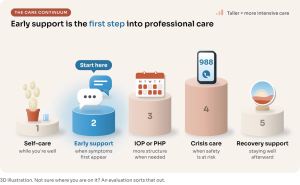
Where it fits. Behavioral health care works as a continuum:
- Prevention and self-care while you’re well
- Early behavioral health support when symptoms first appear
- More intensive treatment, such as intensive outpatient (IOP) or partial hospitalization (PHP)
- Crisis care when safety is at risk
- Recovery support to stay well afterward
Public health experts sometimes call early support “indicated” prevention: help aimed at people already showing early signs, rather than programs for everyone.
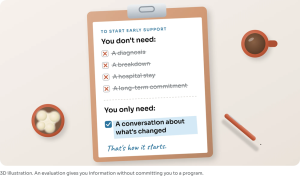
 What it isn’t. Early behavioral health support isn’t crisis care. You don’t need a diagnosis, a breakdown, or a hospital stay to qualify, and it doesn’t lock you into long-term treatment.
 Examples:
- An evaluation after three weeks of low mood that won’t lift
- Weekly therapy when anxiety starts keeping you up at night
- A medication review when a current prescription isn’t helping
- A substance use assessment when one drink to unwind has become several, most nights
- Family therapy when a loved one starts pulling away from home
What Are the Early Signs Someone May Need Behavioral Health Support?
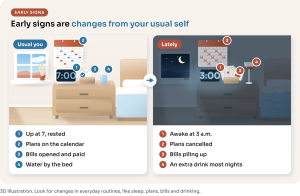
The early signs that someone may need behavioral health support are lasting changes from their usual self, especially changes that continue for two weeks or more:
- Persistent sadness or anxiety. Sometimes it feels less like sadness and more like a flat, empty mood, and you’ve stopped enjoying things you used to love.
- Sudden mood or behavior changes, such as new irritability, outbursts, or risky choices that seem out of character.
- Social withdrawal, which often starts with canceled plans and unanswered texts.
- Sleep or appetite changes, like sleeping 12 hours, lying awake at 3 a.m., or eating for comfort.
- Trouble with everyday responsibilities, such as missed deadlines, late bills, or chores that suddenly feel exhausting.
- Increased substance use, which often starts small, like an extra drink to relax or more cannabis to fall asleep. Here are the early signs that someone may need addiction treatment.
When was the last time you felt like yourself? If the answer is “weeks ago,” that matters. Still, the APA notes that one or two signs alone can’t predict a mental illness. Several signs together that disrupt daily life are worth an evaluation. For a closer look at each sign, read 7 signs you may benefit from behavioral health support.
Early signs in young adults (ages 18 to 25)
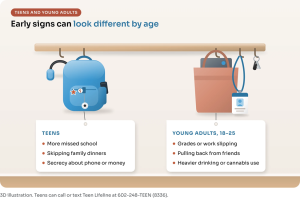
Young adults have the highest rates of mental illness of any adult age group. According to SAMHSA, 28.6% of adults ages 18 to 25 had a mental illness in 2025, and 12.2% had moderate or severe anxiety symptoms in the past two weeks. Warning signs often show up as:
- Poor grades or declining work performance
- Withdrawing friends
- Sleep cycle is interrupted due to stress
- Repeated Heavier drinking or cannabis use
Young adults are also the least likely to get substance use treatment when they need it: only 9.6% did in 2025.
Early signs in teens
For parents, early signs in teens can look like:
- more missed school
- pulling away from friends or family dinners
- irritability that gets mistaken for attitude
- big sleep changes
- new secrecy around phones, money, or substances
Half of all mental illness begins by age 14, according to the APA, and teens often try to handle it alone. In 2025, 87.4% of adolescents with depression who felt they needed care but didn’t get it said they thought they should handle it themselves.
 When Should You Seek Behavioral Health Support?
Seek behavioral health support when severe or distressing symptoms last two weeks or more, when several warning signs appear together and disrupt daily life, or when you rely on alcohol or drugs to cope. Thoughts of suicide or of harming others need immediate help.
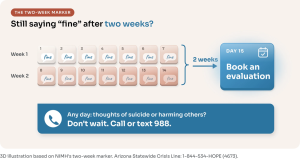 NIMH’s My Mental Health: Do I Need Help? separates mild symptoms lasting under two weeks, where self-care may help, from severe symptoms lasting two weeks or more, which call for professional help.
| Mild symptoms for less than 2 weeks, and you’re still handling work and home | Often manageable with self-care | Prioritize sleep, movement, and time with people; reassess in a week or two |
| Severe or distressing symptoms for 2 weeks or more | Time for a professional evaluation | Call a primary care provider or behavioral health clinic |
| Several warning signs at once that affect work, school, or relationships | Worth an assessment, even if each sign seems small | Schedule a psychiatric evaluation or psychological assessment |
| Drinking or using to cope, or needing more for the same effect | A possible developing substance use problem | Ask for a substance use assessment, and mention any mood symptoms |
| Thoughts of suicide or harming others, severe withdrawal, or feeling unable to stay safe | An emergency | Use the crisis resources below now |
Crisis resources in Arizona
- 988 Suicide & Crisis Lifeline: Call or text 988, or chat at 988lifeline.org, 24/7. For Spanish, press 2 or text AYUDA to 988.
- Arizona Statewide Crisis Line: Call 1-844-534-HOPE (4673), or text 4HOPE (44673).
- Teen Lifeline: Call or text 602-248-TEEN (8336).
- 911: Call if anyone is in immediate danger.
Arizona’s crisis services are available to any resident, regardless of insurance.
Why Is Early Behavioral Health Support Important?
Early behavioral health support is important because symptoms are easier to understand and manage before they spread into work, relationships, and physical health. The APA reports that early intervention can often minimize or delay symptoms, prevent hospitalization, and improve prognosis.
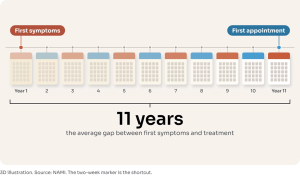
Yet the average gap between first symptoms and treatment is 11 years, according to NAMI; researchers call this gap the duration of untreated illness. NAMI also notes that people with mental illness face up to twice the risk of cardiometabolic disease.
 Here’s how early support makes a difference:
- Clearer answers sooner. An evaluation helps you understand what your symptoms may mean.
- The right level of care from the start, whether that’s weekly therapy or a structured program.
- Less disruption. Symptoms are addressed before they interfere further with work, relationships, or routines.
- More time to practice coping skills and find the ones that work for you.
- A routine that fits your life. Cholla’s clinicians tailor therapy and medication management to your needs, with flexible outpatient schedules.
- Substance use addressed early, alongside mental health symptoms when both are present.
If anxiety or low mood is your main concern, see how behavioral health services can help with anxiety and depression.
Why people wait, and what helps
How bad does it have to get before you ask for help? For many people, nothing ever feels bad enough. In 2025, 49.1% of U.S. adults with a mental illness got no treatment at all. These were the most common reasons among those who felt they needed care but didn’t get it, according to SAMHSA’s 2025 National Survey on Drug Use and Health:
| Thought they should handle it on their own (72.9%)
|
Use the two-week marker. Lasting, distressing symptoms are a health issue, not a willpower test. |
| Thought it would cost too much (61.4%)
|
Ask for an insurance check before your first visit and have costs explained up front. |
| Didn’t have enough time (48.3%)
|
Ask about schedules. Outpatient care fits around work, and IOP sessions run a few hours on several days a week. |
| Weren’t ready to start (47.7%)
|
Start with an evaluation only. It gives you information without committing you to a program. |
| Didn’t know how or where to get treatment (44.9%)
|
Ask a primary care provider for a referral, or call or walk in to a behavioral health clinic. |
| Insurance didn’t pay enough (40.3%) or didn’t cover mental health (39.0%) |
Ask what parity rules mean for your plan (see the insurance FAQ below). |
Adults could give more than one reason, so the shares add up to more than 100%.
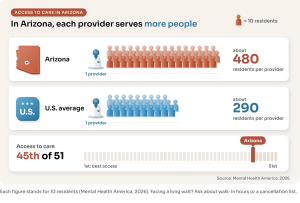
Access is also tight in Arizona. Mental Health America’s 2026 report ranks Arizona 45th of 51 for access to care, with about 480 residents per mental health provider versus 290 nationally. It also reports that 14.2% of Arizona adults with a mental illness are uninsured. Starting sooner gives you more time to find a provider and schedule that fit.
 Early Behavioral Health Support vs. Crisis Care: What’s the Difference?
Early behavioral health support is planned care that starts while symptoms are emerging. Crisis care is immediate help when someone’s safety is at risk. Both matter, but early support aims to keep problems from reaching a crisis.
| When | Symptoms are new, have lasted 2+ weeks, or are starting to affect daily life | There’s immediate risk, such as suicidal thoughts, severe withdrawal, or being unable to stay safe |
| Goal | Understand what’s happening, build skills, and prevent worsening | Keep the person safe and stabilize the situation |
| Where | Outpatient clinic, therapy office, primary care, or telehealth | 988, crisis lines, mobile crisis teams, or the ER |
| Typical services | Evaluation, therapy, medication management, IOP, or PHP | Crisis counseling, mobile response, stabilization, or inpatient care |
| How to start | Walk in, call, or book an assessment | Call or text 988, or call 911 |
| Example | Anxiety that has kept you up most nights for three weeks | Thoughts of ending your life |
Not sure which you need? 988 counselors can talk it through with you and help connect you with services.
What Happens If Behavioral Health Concerns Go Unaddressed?
When behavioral health concerns go unaddressed, their effects tend to compound across sleep, work, relationships, and health. The WHO estimates that depression and anxiety alone cost 12 billion workdays a year worldwide. Not every concern worsens, but waiting gives a problem more room to spread.
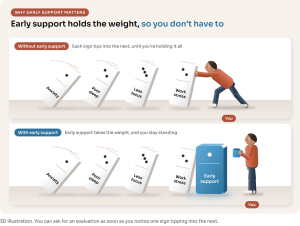
- Sleep → focus → work. Anxiety keeps you up, and poor sleep drains your focus and patience. Mistakes and conflict at work increase, and that stress feeds more anxiety.
- Withdrawal → isolation → lower mood. Canceled plans mean less support, and less support makes low mood harder to shake.
- Drinking to cope → needing more → more anxiety. A drink takes the edge off, then you need more for the same relief, and sleep and mood suffer the next day. Learn how anxiety and substance use can influence each other.
- Irritability → secrecy → strained relationships. Short tempers and hidden habits make honest conversations harder.
- Missed tasks → money stress → more distress. Unpaid bills and missed appointments add pressure to an already heavy load.
- Missed school → falling behind → dropping out. High school students with recent depression symptoms are more than twice as likely to drop out, according to NAMI.
What Types of Behavioral Health Support Are Available?
Behavioral health support ranges from evaluations, therapy, and medication management to structured outpatient programs, substance use treatment, and integrated dual diagnosis care. The right option depends on your symptoms, your safety, and how much time you can commit each week.
| Psychiatric evaluation or psychological assessment | A detailed review of symptoms, history, and goals, with testing when needed | Your symptoms feel confusing or have lasted two weeks or more |
| Individual therapy | One-on-one sessions using CBT, DBT, ACT, or EMDR for trauma | You want private help with anxiety, depression, or trauma |
| Group therapy and skills groups | Clinician-led groups that practice coping and communication skills | You want peer support and a place to practice |
| Medication management | Prescribing, monitoring, and adjusting medication, including medication-assisted treatment (MAT) | A clinician recommends medication |
| Substance use treatment | Assessment, therapy, ambulatory detox, and MAT | Drinking or drug use feels harder to control |
| Dual diagnosis care | Integrated treatment for mental health and substance use together | You drink or use drugs to cope with anxiety, depression, or trauma |
| Family therapy and education | Family sessions plus education and support groups | Family stress is part of the picture, or a loved one wants to help |
If you need more than weekly therapy, the next decision is the level of care:
| Outpatient (OP) | Ongoing sessions for as long as they help | Steady support for manageable symptoms | The least structure |
| Intensive outpatient (IOP) | 3–5 days, 15–25 hours of therapy | Structured care while living at home | More time away from work or school |
| Partial hospitalization (PHP) | About 25 hours of group therapy plus 2–3 individual sessions | Daily structure without 24-hour care | Hardest to fit around a full-time job |
Still deciding? Compare PHP vs. IOP.
Integrated care matters most when mental health and substance use overlap. In 2025, about 1 in 3 U.S. adults with a mental illness (33.9%, or 18.5 million people) also had a substance use disorder. Of those adults, 42.6% got no treatment for either condition, and only 12.7% were treated for both. That’s why Cholla’s dual diagnosis treatment addresses both together.
Who provides early behavioral health support?
NIMH notes that a primary care provider can screen you and refer you to a psychologist, psychiatrist, or clinical social worker. At Cholla, the team includes:
- physicians board-certified in addiction medicine
- a psychiatric nurse practitioner for medication management
- licensed clinicians, including a clinical social worker and licensed addiction counselors
- family nurse practitioners for physical health
- certified peer support staff
How Do You Get Early Behavioral Health Support in Phoenix?
To get early behavioral health support in Phoenix, note what has changed and for how long, rule out an emergency, choose a starting point, verify your coverage, and complete an intake assessment that matches you to a level of care.
Before you start, gather:
- a list of your symptoms and when they began
- your current medications
- any family mental health history you know
- your insurance card and your questions
NIH’s MedlinePlus also suggests bringing someone you trust if that helps you feel comfortable.
- Note what’s changed. Two weeks of distressing symptoms is a useful marker.
- Rule out an emergency. If safety is a concern, use the crisis resources above first.
- Choose a starting point. Ask a primary care provider for a referral, or contact a behavioral health clinic directly. At Cholla, you can call or walk in.
- Verify your coverage. Cholla’s team can verify your insurance before your first visit.
- Complete your intake. An assessment matches you to a level of care (see the FAQ on first appointments).
- Start the recommended care, from weekly therapy to IOP or PHP.
Common snags, and how to avoid them:
- Long waits. Arizona has fewer providers per resident than most states, so ask about walk-in hours or a cancellation list.
- Insurance surprises. Ask whether your plan requires a referral, and get your expected costs before your first visit.
- The wrong level of care. Ask why a level was recommended and what would trigger a step up or down.
- No plan for bad days. Ask what to do if your symptoms worsen before your next appointment.
How to tell the first step worked. You should leave with:
- a completed assessment or a confirmed appointment
- a clear picture of your benefits and costs
- a recommended level of care with a start date
- a plan for what to do if symptoms worsen in the meantime
What Happens After You Start Early Behavioral Health Support?
After you start early behavioral health support, your care team turns your assessment into a plan, teaches skills you can use between sessions, and reviews your progress regularly. That way, therapy, medication, or your level of care can change as you improve.
Building coping skills
Cholla’s individual therapy and skills groups use evidence-based approaches:
- Cognitive behavioral therapy (CBT) helps you spot and change the thought patterns that fuel distress.
- Dialectical behavior therapy (DBT) builds skills for intense emotions, distress, and relationships.
- Acceptance and commitment therapy (ACT) helps you make room for hard thoughts while acting on what matters to you.
- EMDR is available for trauma.
You may notice the difference in a few places:
- Recognizing your triggers gets easier.
- Healthier coping replaces avoiding problems, overworking, or scrolling for hours.
- Stress feels more manageable with tools like slow breathing or a plan for tense conversations.
- Confidence builds as you handle challenges without falling back on old habits.
Tracking progress and adjusting care
Cholla’s progress reviews do 4 things:
- Revisit the goals you set at intake
- Track how your daily functioning is changing at work and at home
- Talk through setbacks and improvements
- Adjust the plan when your needs change
Care can step up or down, for example from PHP to IOP to standard outpatient. Medication management adjusts alongside therapy.
How long does early behavioral health support last?
There’s no fixed timeline. At Cholla, a clinical review sets how long each stage lasts, not a set number of weeks. The review weighs:
- how severe your symptoms are
- your goals and progress
- co-occurring substance use
- any past treatment
- the support you have at home
IOP can be extended if needed, and outpatient care can continue for as long as it helps. Learn how long IOP treatment usually lasts.
Signs early support is working
- You’re sleeping more consistently.
- You’re missing fewer days of work or school.
- You use coping skills without being prompted.
- Urges to drink or use come less often, or pass faster.
- Conversations at home feel less tense.
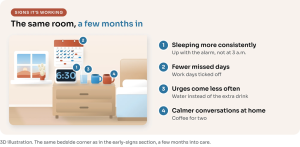
If symptoms aren’t improving after a few weeks, or they’re getting worse, tell your clinician. Plans can and should change.
Staying well after a program ends
What you learn in therapy stays useful long after your last session, especially when you keep practicing. Cholla offers peer and recovery coaching, relapse prevention planning when appropriate, and family education and support groups. Recovery is common. In 2025, 69.4% of adults who had ever had a mental health problem considered themselves recovered or in recovery, as did 73.0% of adults who had ever had a drug or alcohol problem.
Best Practices for Getting the Most From Early Behavioral Health Support
The best practices for early behavioral health support come down to five things: act on the two-week marker, be specific and honest, practice between sessions, involve family when it helps, and know your crisis options before you need them.
| Track symptoms for a week or two (sleep, mood, substance use) | Gives your clinician concrete patterns instead of a vague sense that something’s off | When you’re unsure whether it’s “bad enough” |
| Be upfront about drinking or drug use | Only 12.7% of adults with both conditions get treated for both | If you use substances to cope |
| Practice skills between sessions | Skills stick through repetition in real situations | Daily, especially on hard days |
| Ask how progress is measured | Clear goals make it easier to see and request plan changes | At each progress review |
| Involve a trusted family member, with your consent | The APA calls family members valued partners in early care | When home stress is part of the picture |
| Save crisis numbers in your phone | Help comes faster when you don’t have to search | Now, before you need it |
How Can Families Encourage Someone to Seek Behavioral Health Support?
Families can encourage someone to seek behavioral health support by noticing changes, listening without judgment, and helping with the practical steps. The goal is to make help easier to reach, not to pressure someone into treatment.
You’re not alone in this role. According to NAMI, at least 8.4 million people in the U.S. care for an adult with a mental or emotional health issue, spending an average of 32 hours a week on that care. Family members are often the first to notice changes, like a loved one who starts skipping family dinners or a spouse who gets unusually irritable over small things. One change doesn’t mean someone needs treatment, but if it continues, it’s worth asking how they’re doing. Four approaches can help:
- Start a respectful conversation in a calm, private moment. “I’ve noticed you seem exhausted” lands better than “What’s wrong with you?”
- Listen without judgment. Take their concerns seriously instead of saying “Everyone deals with stress.”
- Encourage professional guidance. This can be as simple as asking whether they’d feel comfortable talking to a therapist.
- Explore options together if they’re interested. You can compare schedules, check insurance, or look into Cholla’s family therapy and family education and support groups.
Respect their boundaries, too. If they’re not ready, let them know you’re there and check in again later. If substance use is involved, read what families should know about co-occurring disorders. If you’re worried about someone’s safety, you can call 988 on their behalf.
How Cholla Behavioral Health Can Help You Take the First Step
Cholla Behavioral Health offers early behavioral health support for mental health and substance use concerns in Phoenix, and it starts with a simple conversation.
Our team builds your care plan from what you share. We verify your insurance up front and explain your recommended schedule and expected costs after the initial consultation. If we’re not the right fit, we’ll help you find care that is.
If you’ve been putting off that first conversation until later, when is later?
Our clinic at 9201 N. 25th Ave., Suite 185, Phoenix, welcomes walk-ins Monday through Friday, 8 a.m. to 5 p.m.
Today is a better answer than later. Call us today!
Frequently Asked Questions (FAQs)
Q1. Do I need a diagnosis before I can get behavioral health support?
No. During intake, Cholla’s team asks about your symptoms and helps determine what kind of care may be appropriate.
Q2. What happens during my first behavioral health appointment?
Before your visit, an intake coordinator asks what led you to seek help. During the visit, the clinical team completes a biopsychosocial and diagnostic assessment, adds psychological testing if needed, and recommends a level of care. If Cholla isn’t the right fit, the team helps you find care that is.
Q3. Can I get help for drinking or drug use before it becomes an addiction?
Yes. If you’re drinking or using more to cope, or cutting back feels harder, a substance use assessment can clarify what’s going on. It can also show whether therapy, medication, or dual diagnosis care makes sense. Learn more about substance use treatment in Phoenix.
Q4. Is what I share with a behavioral health provider confidential?
Yes, with some legal exceptions. HIPAA protects your health information, and 42 CFR Part 2 adds federal protection for substance use treatment records. Cholla’s privacy notice explains that the clinic generally can’t confirm you’re a patient without your written consent. Exceptions include a court order, a medical emergency, and a few others required by law.