
What if you freeze, stumble over your words, or break down during your first behavioral health assessment?
Worrying about how you’ll respond to personal questions can make that first appointment feel overwhelming, especially if you’re afraid it’ll feel more like an interrogation than a conversation.
But you don’t have to explain everything perfectly. You can take a moment to collect your thoughts or tell the clinician you’re struggling to find the words.
Your clinician will ask about what you’ve been experiencing, listen to your concerns, and may use questionnaires to better understand your symptoms. They may also explain their initial impressions and discuss possible next steps with you.
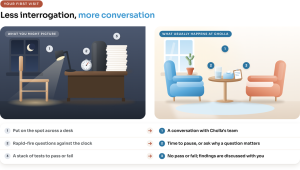 3D illustration based on Cholla’s admissions process: an intake coordinator, then a conversation with the team.
This guide walks you through a typical first behavioral health assessment for adults, including:
- How to book and prepare for your appointment
- What questions you may be asked
- How your clinician may discuss their findings
- What follow-up care may involve
And if you’re considering Cholla Behavioral Health in Phoenix, the guide also covers how to get started there.
What Is a Behavioral Health Assessment?
A behavioral health assessment helps a clinician understand your mental health, emotions, behavior, and substance use, along with the physical health and life circumstances that may affect them. Its purpose is to identify your needs and guide a care plan.
A provider may call this a mental health assessment or conduct it as part of an intake appointment. A biopsychosocial assessment specifically considers biological, psychological, and social factors together.
 3D illustration. Body and mind are linked: NIMH notes that people with depression are at higher risk of heart disease and diabetes, and that chronic illness raises the risk of depression.
This broader view is especially useful when mental health and substance use concerns overlap. For example, someone may use substances to cope with distress, while substance use can contribute to further mental health problems. The National Institute of Mental Health (NIMH) explains that symptoms can overlap, so assessing both concerns can reduce the chance of a missed diagnosis.
A behavioral health assessment may include screening or lead to a more specialized evaluation, but these services have different purposes.
| Service | Main purpose | What it can lead to |
| Screening | Check for signs of a possible concern using a brief tool, such as the PHQ-9 for depression | A closer assessment when the answers suggest one is needed |
| Behavioral health assessment | Review symptoms, history, daily functioning, strengths, and safety needs together | Clinical findings, a diagnosis when appropriate, and care recommendations |
| Psychiatric evaluation | Review mental health concerns with a psychiatric clinician, including medical and medication considerations | Diagnostic clarification and treatment recommendations, which may include medication |
| Psychological testing | Use selected tests to investigate a specific question, such as attention or memory difficulties | Test results that help clarify the concern and guide care |
These services can overlap, and you may need more than one. A positive screening result does not establish a diagnosis by itself; the USPSTF’s anxiety guidance calls for further diagnostic assessment. The specific psychological tests used depend on the person’s needs and the question being investigated, as the American Psychological Association explains.
When Should Someone Consider a Behavioral Health Assessment?
A behavioral health assessment is worth discussing when emotional distress, mental health symptoms, or substance use concerns begin interfering with work, relationships, or daily routines. You do not need to have a diagnosis or wait for a crisis before asking for help.
Those concerns can show up in several ways:
- Persistent anxiety: Worry or panic keeps interrupting your day.
- Low mood: Sadness or a loss of interest makes familiar activities harder to enjoy.
- Mood or behavioral changes: Irritability or pulling away from others begins to affect your relationships.
- Substance use: Alcohol or drug use increases, becomes a way to cope, or causes problems.
- Difficulty with daily activities: You find it harder to sleep, eat regularly, pay bills, keep up with chores, or care for yourself.
You can describe the change without deciding what it means. For example, “I keep missing work because I feel overwhelmed” gives the clinician a clear starting point.
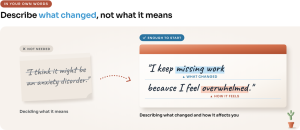 3D illustration. NIMH suggests being specific about when symptoms started, how severe they are and how often they happen.
If you are in the United States and experiencing a mental health crisis, call or text 988 to reach the 988 Suicide & Crisis Lifeline. If you are in immediate danger, call 911 rather than waiting for a scheduled assessment.
Where Can You Get a Behavioral Health Assessment, and What Should You Confirm Before Booking?
You can arrange a behavioral health assessment through a behavioral health clinic, community mental health center, or outpatient provider. A primary care provider can also help you find an appropriate mental health professional.
Once you have a provider in mind, confirm what the appointment includes, what it may cost, and whether your insurance covers it. The first conversation may be an intake call rather than the clinical assessment itself.
| Before booking | What to ask |
| Appointment type | “Is this an intake call, a full assessment, a psychiatric evaluation, or psychological testing?” |
| Timing and format | “How long should I allow, and will the appointment be in person or by video?” |
| Insurance and referrals | “Is the assessing clinician in my plan’s network, and does my plan require a referral or authorization?” |
| Expected cost | “What might I owe, and would testing or another appointment carry a separate charge?” |
| Access and support | “Can I request an interpreter, accessibility support, or permission to bring someone?” |
If you are uninsured or will not use insurance, ask for a written good faith estimate. CMS explains that providers generally must supply one when you request it or schedule care at least three business days ahead.
If you’re looking for an assessment in Phoenix, Cholla’s admissions team can discuss the next steps. Cholla lists its Phoenix office at 9201 North 25th Avenue, Suite 185, Phoenix, AZ 85021, with office hours of 8 a.m. to 5 p.m., Monday through Friday. Call 602-737-1583 to confirm appointment availability, assessment fees, and whether your insurance is accepted.
How Long Does a Behavioral Health Assessment Take?
A mental health assessment interview with written or verbal tests may take 30–90 minutes, according to Kaiser Permanente’s patient guide.
The visit may take longer if you have several concerns to discuss, the clinician needs to review records, or additional testing is needed. Psychological testing or a separate psychiatric evaluation may also require another appointment.
When you book, ask Cholla’s admissions team how long to expect and whether that time includes registration and questionnaires. That gives you a clearer idea of how much time to set aside.
How Do You Prepare for Your First Behavioral Health Assessment?
Prepare for your behavioral health assessment by gathering your health history, listing your symptoms and medications, and writing down your questions. A little preparation helps you remember what matters most when you’re nervous.
NIMH’s guidance on preparing for a health care visit also recommends bringing questions and medication information. These 5 items give you a useful starting point:
- Medical and mental health history: Note past diagnoses, hospital stays, and relevant family history. Bring available records or ask how to have them sent.
- Current symptoms and concerns: Write down when your symptoms started, how often you experience them, and one or two examples of how they affect your day.
- Medications and previous treatment: List your prescriptions and doses, over-the-counter medicines, and supplements. Note any previous treatment, including what helped or caused problems.
- Questions and goals: Write down any questions you want answered and what you hope to understand or change, such as sleeping better, returning to work, or getting help with drinking.
- Insurance and identification: Ask what identification and insurance documents the clinic needs. Cholla’s consultation form requests insurance details such as your insurance provider, member ID, and group number.
These notes do not need to tell your whole story. If you’re having trouble beginning the conversation, you can simply say, “I’m not sure where to start.” The clinician can help guide the conversation.
What Happens During Your First Behavioral Health Assessment?
During a behavioral health assessment, the clinician reviews your concerns and history, asks how you are managing daily life, and considers what support you need. Questionnaires or other evaluations may also help the clinician better understand specific symptoms.
At Cholla, the admissions process begins with a call to an intake coordinator and a conversation with the team. The clinical team then performs a diagnostic assessment, and the findings help guide your care plan.
While the steps may differ between providers, the overall intake and assessment process often covers these 6 areas:
- Registration and consent: Staff collect intake information, review consent forms, and explain privacy practices and what the assessment involves.
- Your reasons for seeking help: You describe what led you to reach out and what you would like to change.
- Personal and medical history: The clinician asks about physical health, medications, previous treatment, and relevant personal or family history.
- Daily life and substance use: The conversation covers work, relationships, sleep, your support system, and alcohol or drug use. Together, these details help the clinician understand how you’re doing day to day.
- Clinical observations and screening tools: The clinician may assess your mood, speech, attention, and thinking as part of a mental status examination. They may also use screening tools, such as the Patient Health Questionnaire-9 (PHQ-9), which has nine questions about depression symptoms. The Generalized Anxiety Disorder-7 (GAD-7) scale has seven questions about anxiety, while the Alcohol Use Disorders Identification Test (AUDIT) has 10 questions about alcohol use. The tools used vary by provider and the concerns being assessed.
- Summary and next steps: The clinician may discuss initial findings, explain what still needs clarification, and recommend care or further evaluation.
If a recommendation isn’t clear, you can ask what it involves and why the clinician is suggesting it.
What Questions Will a Behavioral Health Professional Ask?
A behavioral health professional asks about symptoms, daily functioning, health history, relationships, substance use, safety, and goals. These questions help the clinician understand how different parts of your life may be affecting one another.
Here’s what some of those questions might sound like. The wording and follow-up questions will depend on your concerns.
| Area | Example questions |
| Current concerns | “What has changed recently?” “When did you first notice it?” |
| Mood and stress | “What has been hardest to manage this week?” |
| Daily functioning | “How has this affected your ability to work, eat regularly, pay bills, or look after yourself?” |
| Sleep | “How has your sleep changed?” “Do you feel rested when you wake up?” |
| Relationships and support | “Who can you turn to when things feel difficult?” |
| Health and treatment history | “What medicines do you take?” “What helped or did not help before?” |
| Alcohol or drug use | “Do you drink alcohol or use other drugs?” “If so, how often?” |
| Safety | “Have you had thoughts of hurting yourself or someone else?” |
| Strengths and goals | “What helps you cope?” “What would you most like to change?” |
Some of these questions touch on things you may have kept to yourself. You can ask why a question matters, say you need a moment, or explain that a painful topic is difficult to discuss. If you’re having thoughts of hurting yourself or someone else, sharing that with the clinician can help them understand what support you need right now.
 3D illustration. NIMH also suggests asking for more information about any diagnosis or treatment, and asking about other options if one doesn’t feel right.
Will Your Answers Stay Private?
Your answers are generally kept confidential, although there are situations where the clinic may share information. You can ask who has access to them and when they may be disclosed. The clinic’s privacy notice should explain how it uses and shares your information.
For providers covered by HIPAA, mental health information receives privacy protections, with permitted disclosures for purposes such as treatment. HHS also explains that necessary information may be shared to help prevent serious and imminent harm, subject to applicable law and professional standards.
If your care involves substance use treatment, you can also ask whether your records fall under 42 CFR Part 2. These additional protections apply to records from certain federally assisted substance use disorder programs. They do not automatically cover every mention of alcohol or drug use.
What Happens After a Behavioral Health Assessment?
After a behavioral health assessment, the clinician brings together your history, answers, observations, and any screening results to recommend the next step. That may be treatment, another evaluation, or a combination of both.
A diagnosis may be possible at the first visit, but some concerns take longer to clarify. Clinicians use diagnostic criteria, including those in the American Psychiatric Association’s DSM-5-TR, alongside the information gathered during the assessment.
What matters for your next appointment is understanding how those findings affect the plan.
| Possible recommendation | What it means for you |
| Individual or group therapy | Discuss the treatment goals, approach, and appointment schedule. Cholla lists approaches including cognitive behavioral therapy (CBT) and dialectical behavior therapy (DBT). |
| Psychiatric evaluation or medication support | Review whether medication may help, what its risks and benefits are, and how follow-up will work. Cholla provides medication prescribing and management. |
| A structured outpatient program | Review the recommended level of care and time commitment. Cholla’s outpatient programs include standard outpatient care, intensive outpatient programs (IOP), and partial hospitalization programs (PHP) for adults 18 and older. |
| Further testing or a referral | Clarify a remaining question through psychological testing, medical evaluation, or another provider. Ask who will arrange it and when you should expect to hear back. |
For substance use concerns, placement frameworks such as The ASAM Criteria help clinicians match assessed needs to a level of care. The recommendation should reflect your situation, including your symptoms, safety, and available support.
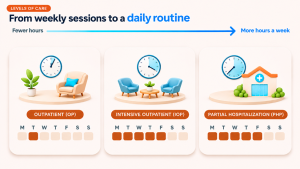 3D illustration; the days shown are examples. Your treatment plan sets the actual schedule for each level of care.
If IOP is recommended, ask how its schedule fits your responsibilities. Cholla publishes 15–25 hours of therapy across 3–5 days a week for its IOP. That is a program-specific commitment, so confirm the schedule for your own plan.
What Should You Confirm Before You Leave?
Before your behavioral health assessment ends, make sure you know what happens next:
- Findings: What have we learned, and what remains uncertain?
- Plan: What do you recommend, why, and what alternatives should we discuss?
- Follow-up: Who will arrange the next appointment, testing, or referral?
- Between visits: What changes should I track, such as sleep, mood, daily functioning, or substance use?
- Contact: Who should I call if symptoms worsen or I have questions before the next visit?
Knowing who is responsible for each step makes it easier to follow through. If a referral is being arranged or you’re waiting for test results, agree on when to check back rather than leaving the timing open.
What If the First Assessment Does Not Give You a Clear Answer?
A behavioral health assessment can identify useful next steps even when it does not produce a firm diagnosis. This can happen when symptoms overlap, records are missing, or specialized testing is needed.
Ask the clinician what information they still need and how they plan to obtain it. For example, they may request earlier treatment records, recommend a medical evaluation, or suggest a separate psychological assessment before drawing a conclusion.
If the clinician’s initial explanation doesn’t seem to fit your experience, describe what feels inaccurate and ask them to explain their reasoning. If you’re still unsure, you can ask for a second opinion. You may not have a final answer that day, but you should know what the clinician plans to do next.
Take the First Step Toward Understanding Your Needs
Your first behavioral health assessment gives you a place to describe what has changed and ask what might help. You do not need to arrive with a diagnosis or a treatment plan already worked out.
At Cholla Behavioral Health in Phoenix, our team assesses mental health and substance use concerns and uses the findings to build a care plan. If you’re thinking about scheduling an assessment, our admissions team can discuss your concerns, appointment options, and expected costs.
You don’t need perfect words or a crisis to reach out.
Call Cholla’s admissions team at 602-737-1583 to discuss your first assessment.
Frequently Asked Questions (FAQs)
Q1. How Do You Pass a Behavioral Assessment Test?
A clinical behavioral health assessment has no pass or fail result. Honest answers help the clinician understand your needs, so there is no “right” response to rehearse.
If you’re asking about a pre-employment behavioral test, that’s different: it assesses work-related traits rather than helping a clinician plan care.
Q2. Can You Bring Someone to a Behavioral Health Assessment?
Ask the clinic whether a friend or relative can join you during the assessment. The NIMH notes that a trusted person can offer support, help you ask questions, and help you remember what was discussed.
If they can join you, let the clinician know whether you want them present for all or only part of the conversation.
Q3. Can a Behavioral Health Assessment Take Place Online?
Your first behavioral health assessment may be possible online, depending on the provider and what needs to be evaluated. According to HHS telehealth guidance, some parts of behavioral health care, including mental health screening, can be provided remotely.
Ask Cholla whether your appointment can be completed by video and whether any testing or follow-up requires an in-person visit.